Most of the time, we take vision for granted, until something goes wrong.
While the onset of serious eye diseases such as cataracts and macular degeneration reminds us of the importance and fragility of sight, what most people do not realise is how even the ordinary day-to-day experience of vision involves an extraordinary amount of work on the part of our eyes.
Perhaps sometimes you do notice it after a long day at work. After staring at screens all day long, your eyes feel dry, gritty, and perhaps a little watery. Your vision becomes blurry, and you know you have strained your eyes.
But what exactly is happening inside your eyes?
Beneath the familiar feeling of ‘tired eyes’ are different kinds of work: the retina’s continuous cellular activity, the eye’s effort of holding things in focus, and the upkeep of the delicate tear film on the eye’s surface.
Seeing feels effortless, but physiologically, it isn’t. That is the reason why we need to look after our eyes every single day.
1. The energy demand you don’t feel
At the back of your eye, a thin layer of nerve tissue turns light into information your brain can interpret. This is the retina, and it is among the body’s most metabolically active tissues.
Its light-sensitive cells, the photoreceptors, do much more than receive an image. They maintain electrical differences across their membranes, pass signals onward, and continually renew parts of their light-sensitive machinery. All of this requires ATP, the usable energy our cells make from nutrients. Their inner segments are densely supplied with mitochondria to help meet that demand.¹

That energy use has a biological cost. Mitochondria generate reactive oxygen species as they make ATP, and these reactive molecules can trigger oxidative stress when they are not kept in check. The retina is especially vulnerable because it consumes large amounts of oxygen, while photoreceptor membranes are rich in fats that oxidise easily. Antioxidant defences normally keep this chemistry in balance, but their job becomes harder with age.¹
Photoreceptor cells are damaged and lost as we age, and their death tends to be irreversible. Human retinal studies suggest that rods are particularly vulnerable in the central retina, while cones remain more stable. Metabolic demand is not the only cause, but it helps explain why these cells depend on continuous antioxidant protection and repair.²
Intense light can add a separate burden. At sufficiently high exposures, shorter-wavelength visible light, such as blue light from LED screens, can drive oxidative reactions in the retina.³ Regular breaks from screens are beneficial. Meanwhile, in daily life, bright sunlight matters far more than ordinary screens: UV-blocking sunglasses are essential outdoors.
2. Holding the world in focus
Your eyes have an autofocus system, called accommodation. To focus on something close, a ring of muscle inside each eye, the ciliary muscle, contracts. This reduces tension in the fine fibres supporting the lens, allowing the lens to become rounder and increase its focusing power.⁴
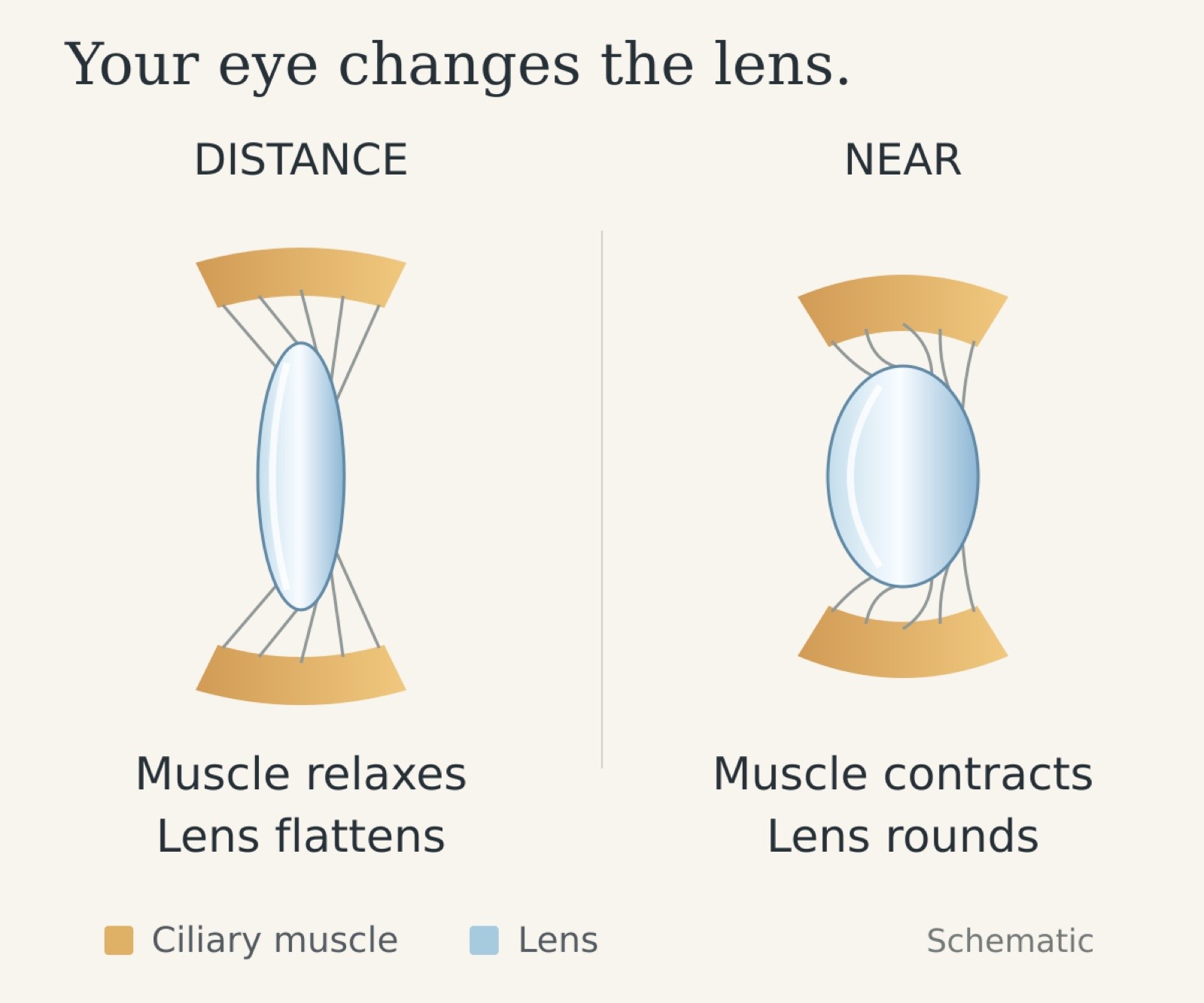
Near work like reading and looking at your desktop screen keeps this system engaged and strains the ciliary muscles over time.
There is also a separate process when your eyes look at a nearby object: convergence. The eyes must turn inward together so that the images they receive line up.
Sustained near work can contribute to brow ache, visual fatigue, and difficulty shifting focus, particularly if your prescription or eye coordination needs attention.
This is why rather than scrolling on your phone, looking into the distance is the break that your eyes need. It reduces the demand for near focus. Enlarge text rather than bringing the screen closer, keep a comfortable working distance, and regularly look across the room or out of a window. If refocusing problems or headaches keep returning, an eye examination can identify what needs correcting.
However, even if your eyes’ focusing system is working properly, there might be another reason your eyes feel uncomfortable and irritated.
3. The surface that needs a fresh coat
Every blink spreads a thin film of tears over the cornea. This film keeps the surface moist and comfortable, and it also makes it optically smooth, so it contributes to the quality of the image entering your eye. Its oily outer layer helps slow evaporation.⁵
During screen use, we tend to blink less often, and some blinks are incomplete. This leaves the tear film less evenly replenished, allowing it to thin between blinks and making dryness and irritation more likely.⁶
An unstable tear film can cause grittiness and burning. It can also make vision fluctuate: as the film becomes uneven, the eye surface loses some of its optical smoothness. A complete blink spreads tears across the surface again, which can briefly bring blurred text back into focus.
How can you reduce digital eye strain and dry eye?
Take regular breaks from near work, look into the distance, and blink fully to ease focusing demands and refresh the tear film.
Use artificial tears to relieve dryness, choosing preservative-free formulations for frequent use and considering lipid-containing drops for evaporative dry eye.
Consider lubricating gels or ointments at bedtime if dryness persists overnight, since thicker formulations can temporarily blur vision.
If the eyelids’ oil-producing meibomian glands are blocked, warm compresses and appropriate lid hygiene can help improve oil flow.
Certain nutrients have proven benefits for digital eye strain, such as lutein and zeaxanthin. Omega-3s are commonly recommended for dry eye.
Care for the Eyes That Work Hard for You Every Moment
These three systems explain why eye care needs more than a single fix. Focusing benefits from changes of distance and the right prescription. The surface benefits from blinking and appropriate dry-eye care. The retina depends on a continuing supply of nutrients and functioning cellular defences.
Nutrition supports these systems from within. Lutein and zeaxanthin are particularly important: they are dietary carotenoids that accumulate in the macula, the part of the retina responsible for sharp, detailed vision. They form the macular pigment, which, like an internal blue light filter for your eyes, blocks some blue light before it reaches the photoreceptors. Their antioxidant activity helps protect retinal cells against oxidative stress.⁷
Human studies have investigated how these functions translate into visual benefits. A placebo-controlled trial found improvements in recovery after bright-light exposure and chromatic contrast following lutein and zeaxanthin supplementation.⁸ Research in adults with high screen use has also reported reduced eye strain and visual fatigue after supplementation with macular carotenoids, supporting a role for nutrition alongside better screen habits.⁹
From Clearer
Clearer™ Eye Health Supplement is commonly taken for vitreous health and eye floaters, but its ingredients have research-proven benefits for general eye health. Alongside lutein and zeaxanthin, it provides grape seed extracts, rich in proanthocyanidins with strong antioxidant and anti-inflammatory activity. This ingredient has also been investigated clinically: a year-long randomised trial in people with non-proliferative diabetic retinopathy found that grape-seed proanthocyanidin extract improved retinal hard exudates, the fatty deposits associated with leaking blood vessels, compared with placebo.¹⁰
Preclinical research adds another dimension: in aged mice and cultured retinal pigment epithelial cells, grape seed extracts reduced markers of cellular senescence and helped preserve mitochondrial function and the cells’ protective barrier. These cells support the photoreceptors that make vision possible.¹¹
Clearer also provides zinc, an essential mineral for normal retinal function and the eye’s antioxidant defences.¹²
Meanwhile, vitamin C provides antioxidant protection and is essential for collagen formation.¹³ Collagen forms the fine framework of the vitreous gel and is also found in the retina’s inner limiting membrane and the capsule surrounding the lens, helping give these structures their organisation and strength.¹⁴,¹⁵
Protecting the eye’s proteins also means limiting glycation: chemical changes caused when sugars react with proteins. Clearer’s bitter orange contains hesperidin, a citrus flavonoid. Japanese preclinical studies found that an orally administered hesperidin derivative supported antioxidant defences and reduced cataract formation in rats.¹⁶ In a separate laboratory study, hesperetin, a metabolite of hesperidin, reduced glycation of lens proteins and limited lens hardening.¹⁷ This research concerns the lens’s proteins, including crystallins, which help it remain clear and focus light.
Already taking Clearer and spending more than six hours a day on screens? Visor™ Eye Health Supplement complements your routine with additional lutein and zeaxanthin, bilberry extract, and vitamins C, E, and B2. Vitamin E is a fat-soluble antioxidant that helps protect cell-membrane lipids from oxidation, a role particularly relevant to the retina’s fat-rich photoreceptor membranes.¹⁸ Lipids also help the tear film resist evaporation, making care for the eye’s oily surface layer another part of the routine. Visor’s beta-carotene provides a source of vitamin A, which the eye needs to make visual pigments for low-light vision and maintain a healthy corneal and conjunctival surface.¹⁹
Supporting your eyes’ antioxidant defences is one part of the picture; managing incoming light is another. UmbraPlus™ tinted glasses block 100% of UV, filter blue light, and soften harsh white lighting, offering a warmer view for people who find bright workspaces uncomfortable. The dark orange lenses provide stronger filtering than the light yellow option.²⁰ If light sensitivity accompanies your digital eye strain, the tinted glasses may make screen work more comfortable; some people with floaters may also find the floaters less noticeable against bright backgrounds.
Filed under
Everyday eye care